


Let’s be honest. For years, sunscreen has been the skincare step everyone loves to hate. We conjure images of thick, greasy, chalky white paste that smells like a tropical-scented candle, clogs pores, and leaves an oil slick on our face. It was the product we tolerated for a beach day, but a daily chore we begrudgingly endured or, more often, skipped entirely.
But what if we told you that this perception is now completely outdated? The world of sun protection has undergone a radical scientific and cosmetic revolution. Today’s best sunscreens are elegant, lightweight, and cosmetically invisible, formulated to feel more like luxurious moisturizers than the goopy lotions of the past.
This is critical, because sunscreen is not just for beach days. It is, without exaggeration, the single most important product in any skincare routine for the long-term health and appearance of your skin. This guide will dismantle every excuse, demystify the science, and provide you with a clear roadmap to finding a sunscreen so comfortable, you’ll actually look forward to applying it every morning.
Part 1: The “Why” – It’s About So Much More Than Preventing a Burn
Sunscreen is the ultimate “Protect” pillar of any routine, a concept we introduced in our Foundational Guide to Building a Skincare Routine. Its importance goes far beyond preventing a temporary red burn. The sun emits a spectrum of ultraviolet (UV) radiation, and two types are of primary concern for our skin:
- UVB (Burning Rays): These are shorter wavelengths that penetrate the epidermis (the top layer of skin). They are the primary cause of sunburns and play a key role in developing skin cancer.
- UVA (Aging Rays): These are longer wavelengths that penetrate deeper into the dermis. They are the silent assassins of skin health. UVA rays are present with equal intensity during all daylight hours, year-round, and can penetrate clouds and glass. They are responsible for:
- Collagen Degradation: Breaking down the firming proteins in your skin, leading to fine lines, wrinkles, and loss of elasticity.
- Hyperpigmentation: Triggering the overproduction of melanin, causing sun spots, dark spots, and melasma.
- Free Radical Damage: Generating oxidative stress that damages skin cells on a DNA level.
Every single day you skip sunscreen, you are leaving your skin exposed to the number one cause of premature aging.
Part 2: The Great Divide – Chemical vs. Mineral Sunscreens
This is the biggest point of confusion for consumers. Both are effective, but they work in fundamentally different ways.
Chemical Sunscreens
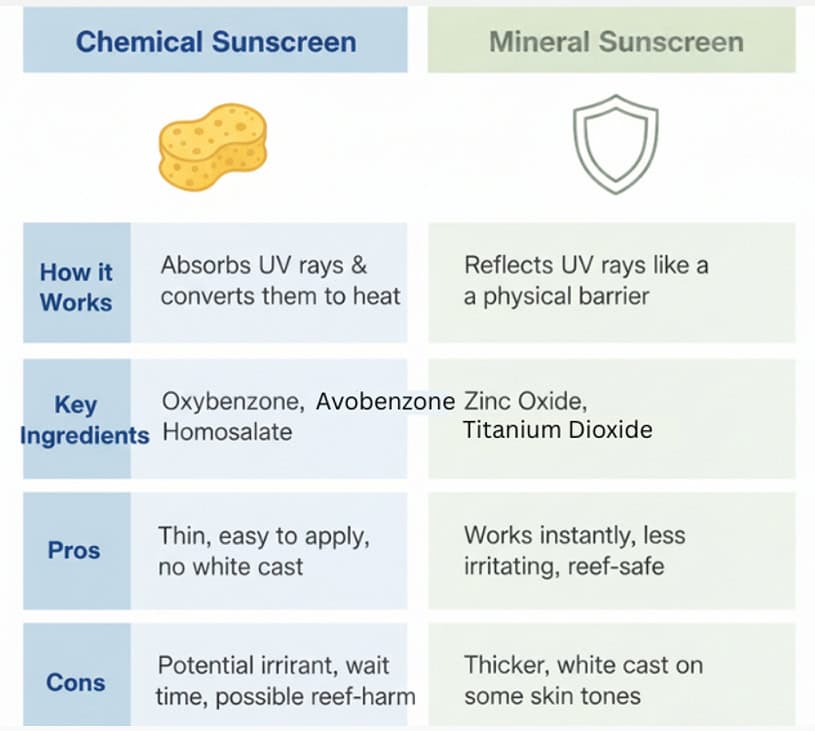
- How They Work: These formulas contain organic compounds that absorb UV radiation as it penetrates the skin and convert it into a small amount of heat, which is then released. Think of it like a sponge that soaks up UV rays.
- Common Active Ingredients: Avobenzone, Octinoxate, Octocrylene, Oxybenzone, Homosalate.
- Pros:
- Tend to be very lightweight and spread easily.
- Rub in completely clear with no white cast.
- Cosmetically elegant and work well under makeup.
- Cons:
- Can sometimes cause stinging or irritation for very sensitive or rosacea-prone skin.
- Some ingredients (like Oxybenzone) have faced environmental concerns and consumer skepticism, though they are FDA-approved as safe for human use.
Mineral (Physical) Sunscreens
- How They Work: These formulas use inorganic mineral particles that sit on top of the skin and create a physical barrier that reflects and scatters most of the UV rays away from the skin.
- Active Ingredients: Zinc Oxide and/or Titanium Dioxide.
- Pros:
- Extremely gentle and well-tolerated by sensitive and reactive skin.
- Offer broad-spectrum protection immediately upon application.
- Zinc Oxide is a skin-soothing agent, making it fantastic for acne-prone or rosacea-prone skin.
- Cons:
- Can traditionally leave a noticeable white or purplish cast, especially on deeper skin tones.
- Can feel thicker or heavier than chemical formulas.
The Modern Solution: Hybrid & Micronized Formulas
In 2025, the lines are blurring. “Hybrid” sunscreens combine both chemical and mineral filters to offer the best of both worlds. Furthermore, modern mineral sunscreens now use micronized or nano-sized Zinc Oxide, which dramatically reduces the white cast, making them far more cosmetically elegant.
Part 3: Decoding the Label – What SPF and “Broad-Spectrum” Really Mean
- SPF (Sun Protection Factor): This number primarily measures protection against UVB rays (the burning ones). It indicates how much longer it would take for your skin to redden with the sunscreen on compared to without it.
- The Recommendation: Dermatologists worldwide recommend a daily minimum of SPF 30. SPF 30 blocks ~97% of UVB rays, while SPF 50 blocks ~98%. The increase in protection is marginal, so diligent application is more important than an ultra-high number.
- Broad-Spectrum: This is a non-negotiable term you must see on the label. It certifies that the sunscreen protects you from both UVA (aging) and UVB (burning) rays. An SPF number alone is not enough.
- PA+ Rating: You’ll often see this on Asian and European sunscreens. It specifically rates the level of UVA protection, with PA++++ offering the highest level. It’s a great indicator of superior anti-aging protection.
Part 4: Finding Your Formula – A Sunscreen for Every Skin Type
- For Oily & Acne-Prone Skin: Look for ultra-light fluids, gels, or “watery essence” formulas. Opt for products labeled “oil-free” and “non-comedogenic.” Chemical sunscreens are often a great textural fit. Mineral sunscreens with Zinc Oxide are also excellent due to their anti-inflammatory properties.
- For Dry & Mature Skin: Seek out hydrating lotions or cream formulas that feel nourishing. These often contain added beneficial ingredients like hyaluronic acid, ceramides, and antioxidants. Hydrating mineral or hybrid formulas are a fantastic choice.
- For Sensitive & Rosacea-Prone Skin: Mineral sunscreens are your holy grail. Stick to formulas where the only active ingredients are Zinc Oxide and/or Titanium Dioxide. Ensure the product is also fragrance-free and alcohol-free.
- For Deeper Skin Tones: The dreaded white cast is the primary concern. The best options are:
- Elegant Chemical Sunscreens: These are formulated to be completely invisible on all skin tones.
- Tinted Mineral Sunscreens: These use iron oxides to add a tint that counteracts the white cast, providing beautiful, even coverage.
- Modern Micronized Mineral Sunscreens: Look for formulas specifically marketed as having “no white cast.”
Part 5: The Application Masterclass – The Rules You Can’t Break
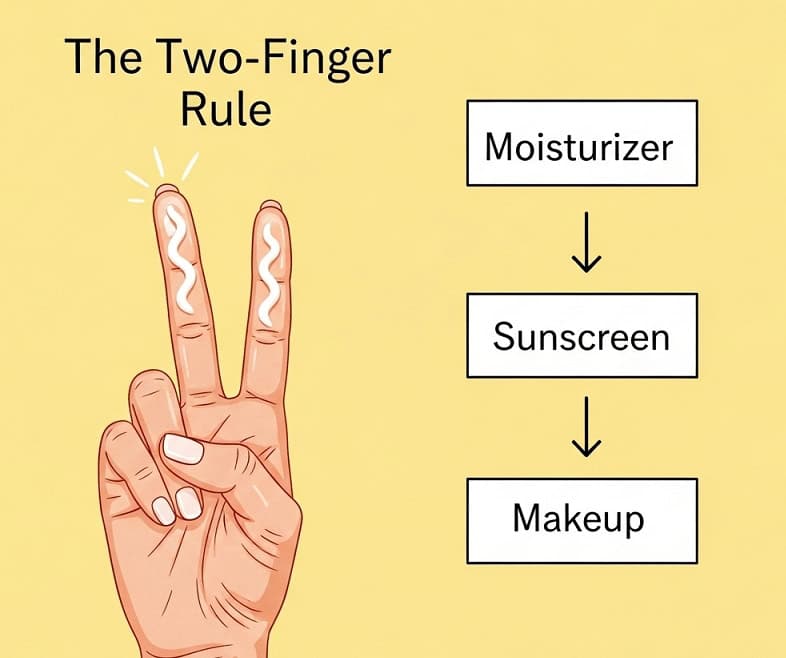
- The Correct Amount: The biggest mistake people make is not using enough. For the face and neck, you need approximately 1/2 teaspoon, which is more than you think. A great visual guide is the “Two-Finger Rule”: Squeeze a line of sunscreen down the length of your index and middle fingers, and apply that amount to your face and neck.
- Order of Application: Sunscreen is ALWAYS the final step in your morning skincare routine, applied after your moisturizer and before your makeup.
- Give it Time: Allow your sunscreen to absorb for a few minutes before applying makeup for the smoothest application.
- Reapplication: For a typical office day, one thorough application in the morning is sufficient. If you are outdoors for extended periods, sweating, or swimming, you must reapply every two hours.
- Reapplying Over Makeup: Use a sunscreen mist, a powder sunscreen with an SPF rating, or a cushion compact to top up your protection without disturbing your makeup.
FAQ Section: Your Sunscreen Questions, Answered

- 1. Is the SPF in my foundation or moisturizer enough?
- No, almost never. To get the SPF number advertised on the label, you would need to apply a very thick, 1/2 teaspoon layer of that product, which no one does. Think of the SPF in your makeup as a bonus layer of protection, not your primary defense.
- 2. Do I really need to wear sunscreen on cloudy days or in the winter?
- Yes. Up to 80% of UVA (aging) rays penetrate through clouds. If there is daylight, there is skin-damaging radiation. This is a non-negotiable daily habit, 365 days a year.
- 3. I use Retinol and AHAs/BHAs. Does that matter?
- Yes, it matters immensely. These ingredients increase your skin’s photosensitivity. As we explain in our guides to Retinol and Exfoliants, using these powerful actives without diligent, daily sun protection is actively damaging your skin.
- 4. I’m worried about the chemicals in sunscreen. Are they safe?
- The active ingredients in sunscreens sold in most countries have been rigorously tested and approved as safe for human use by regulatory bodies like the FDA. The risks associated with sun exposure and skin cancer are proven and far outweigh the hypothetical risks of using sunscreen. If you have concerns, mineral sunscreens with Zinc Oxide and Titanium Dioxide are an excellent and universally trusted option.
Conclusion: The Ultimate Anti-Aging Investment
The best anti-aging product on the market is not a rare, expensive serum; it’s a humble bottle of broad-spectrum sunscreen, used consistently. By shedding the outdated perceptions of greasy formulas and embracing the elegant, comfortable options available today, you are making the single most powerful investment in your skin’s future health and appearance. Find a formula you love, make it a non-negotiable part of your morning ritual, and your skin will thank you for decades to come.

