


In the world of beauty, primer is one of the most promised-upon products. It’s marketed as the magic elixir for a flawless canvas, the secret weapon for all-day wear, the instant filter for your pores. Yet, for so many, it remains a source of frustration. You apply it diligently, but your makeup still slides off. You use a “smoothing” formula, but your foundation looks even more textured. Why does this supposed miracle product so often feel like just another useless, extra layer?
The answer is simple: you are likely using the wrong primer for your skin type, or the wrong type of primer for your foundation.
Welcome to your definitive guide to primers. We are moving beyond the marketing claims to give you a complete education on what primers actually do, how they work on a chemical level, and how to select the perfect formula to solve your specific skin concerns. Whether your face is a persistent oil slick, a desert of dry patches, or a confusing combination of both, this guide will empower you to finally choose a primer that works with your skin and makeup, not against them.
Part 1: What Is a Primer and What Does It Actually Do?
Before we can choose the right one, we must understand its core functions. At its most basic level, a primer is a preparatory product applied after your skincare and before your makeup. Its primary purpose is to create an ideal canvas for your foundation. It achieves this in three key ways:
- It SMOOTHS the Canvas: Many primers contain ingredients like silicones (e.g., dimethicone) that fill in fine lines, textural irregularities, and large pores, creating a silky, even surface. This prevents foundation from settling into creases and clinging to uneven texture.
- It GRIPS the Makeup: Certain primers have a slightly tacky finish that gives your foundation something to adhere to, dramatically increasing its longevity and preventing it from fading or breaking down throughout the day.
- It CREATES a Barrier: Primer forms a thin barrier between your skin and your makeup. This is crucial. For oily skin, it stops excess sebum from breaking down your foundation. For dry skin, it stops the skin from absorbing the moisture out of your foundation, which is a primary cause of a cakey finish.
As we detailed in our Ultimate Guide to a Flawless Foundation Base, creating this barrier is a non-negotiable step for a long-lasting, professional finish.
Part 2: The Primer Matrix – A Deep Dive into Each Formula Type
Not all primers are created equal. In 2025, the market is highly specialized. Choosing the right one means matching its primary function to your primary skin concern.
For Oily & Acne-Prone Skin: Mattifying & Oil-Controlling Primers
- Who They’re For: Anyone whose main complaint is their T-zone becoming shiny within hours of applying makeup. Also excellent for those in humid climates.
- How They Work: These are formulated with absorbent powders and minerals like silica, talc, or clay. These ingredients act like microscopic sponges, soaking up excess sebum as it’s produced throughout the day, keeping your skin looking velvety and shine-free for longer. Some also contain ingredients like salicylic acid to help keep pores clear.
- Key Ingredients to Look For: Silica, Dimethicone, Polymethylsilsesquioxane, Salicylic Acid, Willow Bark Extract.
- Pro Tip: You don’t need to apply a mattifying primer all over your face. Use it strategically only on your oiliest areas—typically the forehead, nose, and chin—to avoid drying out other parts of your face.
For Dry & Dehydrated Skin: Hydrating Primers
- Who They’re For: Individuals whose foundation looks cakey, patchy, or emphasizes dry flakes. Also perfect for mature skin where foundation tends to settle into dehydration lines.
- How They Work: These primers are essentially a lightweight, makeup-friendly moisturizer. They are packed with humectants, which are ingredients that attract and bind water to the skin. This provides a plump, juicy canvas that prevents the skin from “drinking” the moisture from your foundation.
- Key Ingredients to Look For: Hyaluronic Acid, Glycerin, Squalane, Coconut Water, Aloe Vera, Ceramides.
- Pro Tip: For exceptionally dry skin, mix a small drop of your hydrating primer directly into your foundation. This sheers it out slightly and gives an extra boost of luminosity and moisture.
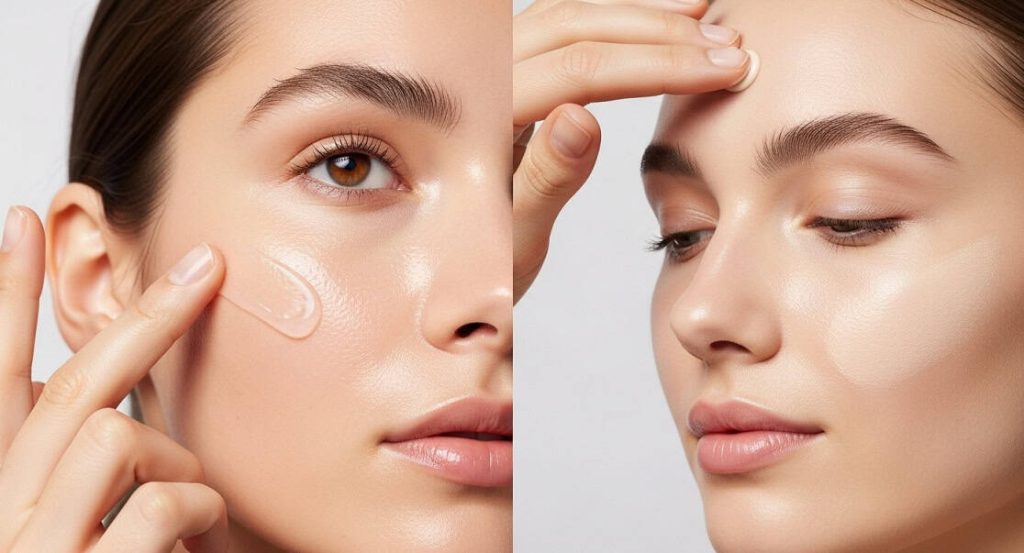
For Dull or Lackluster Skin: Illuminating & Radiant Primers
- Who They’re For: Anyone who wants to achieve that coveted “lit-from-within” glow. Excellent for making a matte foundation look more skin-like or for revitalizing tired-looking skin.
- How They Work: These primers contain very fine, light-reflecting particles like mica or crushed pearl. These particles don’t add glitter; instead, they catch the light in a subtle way, creating the illusion of healthier, more radiant, and more luminous skin. They come in various tones like champagne, rose gold, or pearly white.
- Key Ingredients to Look For: Mica, Titanium Dioxide, Tin Oxide, Squalane, Vitamin C.
- Pro Tip: Wear it alone on “no-makeup” makeup days for a healthy glow. You can also tap a tiny amount onto the high points of your face (cheekbones, brow bone) over your foundation as a subtle, natural-looking liquid highlighter.
For Textured Skin & Large Pores: Pore-Filling & Blurring Primers
- Who They’re For: Those whose primary concern is the appearance of visible pores, acne scarring, or fine lines.
- How They Work: These are typically silicone-heavy primers with a thick, almost spackle-like consistency. The silicones create a smooth, invisible film over the skin, effectively filling in indentations and creating a flawlessly even surface. This effect is often referred to as “blurring” or “soft-focus.”
- Key Ingredients to Look For: Dimethicone, Cyclopentasiloxane, Dimethicone Crosspolymer, Polysilicone-11.
- Pro Tip: This is a product where technique is everything. Instead of rubbing it in, use a gentle patting or pressing motion. This pushes the product into the pores and fine lines without disturbing the smooth film it creates. Use sparingly!
For Discoloration & Redness: Color-Correcting Primers
- Who They’re For: Anyone dealing with specific tonal issues like rosacea, dark spots, or sallow skin.
- How They Work: Based on color theory, these primers use opposite colors on the color wheel to neutralize discoloration.
- Green: Cancels out intense redness (from rosacea or acne).
- Peach/Orange: Neutralizes blue or purple tones (like dark circles or hyperpigmentation on medium to deep skin).
- Yellow: Brightens and counteracts purple tones (for general dullness).
- Lavender: Cancels out unwanted yellow undertones, brightening sallow skin.
- Pro Tip: Use these only on the specific areas of concern. Applying a green primer all over your face will leave you with a ghoulish, gray cast. A little goes a very long way.
Part 3: The Chemistry Lesson – Why Silicone vs. Water-Based Matters
This is the single most important technical aspect of choosing a primer, and the reason many people’s makeup separates. Your primer and your foundation must be chemically compatible. Think of it like mixing oil and water—they repel each other.
- Silicone-Based Products: These feel slippery, silky, and smooth. They create a blurring film over the skin.
- How to Identify: Look for ingredients ending in -cone, -methicone, or -siloxane near the top of the ingredient list (e.g., Dimethicone, Cyclopentasiloxane).
- Water-Based Products: These feel more like a lightweight lotion or gel. They absorb into the skin more readily.
- How to Identify: The very first ingredient will be Water/Aqua. They will not have silicones high up on the ingredient list. (Note: Many will still have some silicones lower down for texture, but the primary base is water).
The Golden Rule:
- Silicone Primer + Silicone Foundation = Smooth Application
- Water-Based Primer + Water-Based Foundation = Seamless Blend
- Silicone Primer + Water-Based Foundation = Pilling & Separation (The water-based foundation can’t properly grip the slick silicone primer).
Part 4: Pro-Level Application – Multi-Priming for Combination Skin
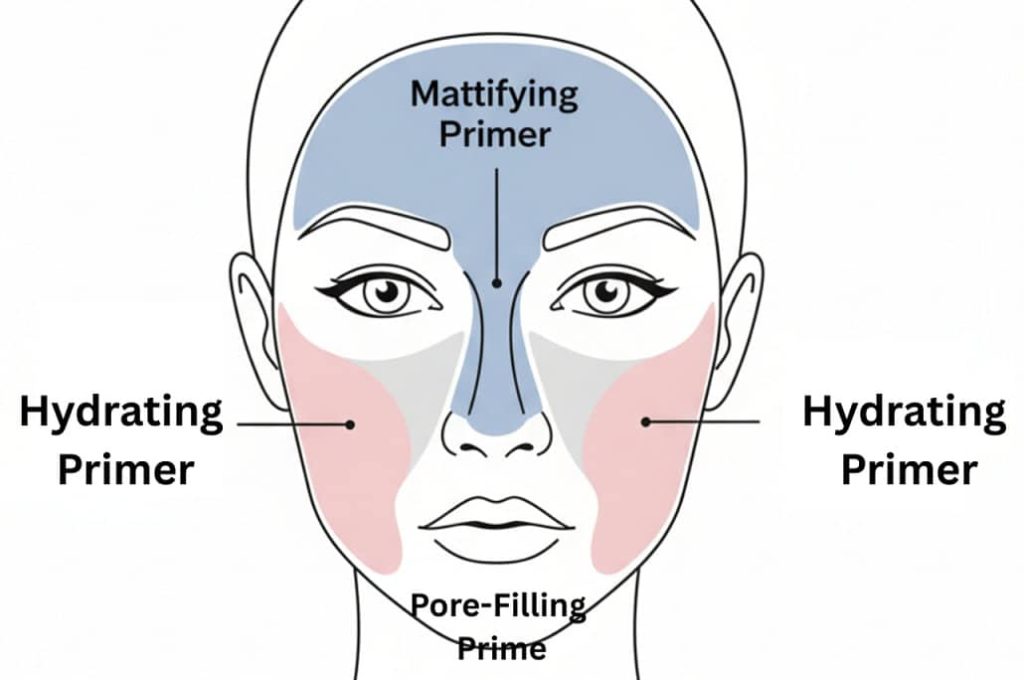
If you have combination skin—an oily T-zone but dry cheeks—the idea of using one primer all over your face is a recipe for failure. The solution is Multi-Priming.
This technique involves using different primers on different parts of your face to address specific concerns, just as you would with multi-masking in skincare.
A Typical Multi-Priming Routine:
- Apply a pore-filling/blurring primer to the areas with the most texture, like around the nose and on the forehead.
- Apply a mattifying primer to the oiliest parts of your T-zone.
- Apply a hydrating or illuminating primer to the cheeks, under-eye area, and any other dry spots.
This targeted approach ensures every part of your face is perfectly prepped, resulting in a balanced, long-lasting finish.
FAQ Section: Your Primer Problems, Solved

- 1. Can I use primer instead of a moisturizer? No. These are two fundamentally different products. A moisturizer is skincare designed to hydrate and nourish the skin’s deeper layers. A primer is a makeup product designed to sit on top of the skin to create a smooth surface. Always apply moisturizer first.
- 2. Why does my primer sometimes make my foundation look more cakey? This usually happens for two reasons: 1) You’re using way too much product (a pea-sized amount is enough for the whole face), or 2) You are using a thick, silicone-based pore-filling primer all over your face, including on dry patches, which can cause foundation to cling and look heavy. Use it sparingly and only where needed.
- 3. How long should I wait between applying primer and foundation? This is critical. You must give your primer at least 60 seconds to set and form a film on the skin. If you apply foundation while the primer is still wet, they will mix together and smudge rather than layer properly, defeating the purpose.
- 4. My primer pills up no matter what I do. What’s wrong? First, check the compatibility with your moisturizer and foundation (water vs. silicone). Second, you may be applying too much of either your moisturizer or your primer. Third, ensure you’re giving your skincare enough time to absorb before applying primer. Rushing is the enemy of a smooth base.
- 5. Do I really need a primer if my skin is in good condition? Need? No. But will it improve the look and longevity of your makeup? Absolutely. Even on perfect skin, a “gripping” primer can extend the wear time of your foundation by hours, while an “illuminating” primer can add a beautiful, subtle radiance that skin alone can’t produce.
Conclusion: Primer as Your Strategic Partner
Stop thinking of primer as just another obligatory step and start seeing it as your strategic partner in achieving a flawless base. By correctly identifying your skin’s primary needs be it hydration, oil control, or texture-smoothing and understanding the crucial role of chemical compatibility, you can transform primer from a source of frustration into your most valuable makeup tool. A well-chosen primer doesn’t just promise a better result; it delivers it.

