


In the skincare hall of fame, Vitamin C holds a place of honor. It’s the ingredient dermatologists universally recommend, the one promised to deliver a brighter, firmer, and more radiant complexion. It’s presented as the ultimate daytime protector, the secret weapon for a healthy glow. Yet, for many, the Vitamin C journey is paved with confusion: sticky serums, a strange metallic smell, and the nagging question—is this even doing anything?
Worse yet, some experience irritation, while others watch their expensive new serum turn an ominous shade of brown in a matter of weeks. The truth is, not all Vitamin C serums are created equal. Their effectiveness hinges entirely on their formulation, stability, and how you use them.
This is your definitive guide to a notoriously tricky ingredient. We will demystify the science, decode the different forms of Vitamin C, and provide you with a clear roadmap for selecting a potent, stable, and effective serum. It’s time to stop guessing and start investing in a product that will deliver the remarkable results you’ve been promised.
Part 1: The Skincare Superstar – Why Vitamin C is a Non-Negotiable
Vitamin C, in its various forms, is the most abundant antioxidant in human skin. When applied topically, it’s a powerhouse that provides three core, clinically-proven benefits. It is the quintessential “Treat” step in any morning routine, a concept we introduced in our Foundational Guide to Building a Skincare Routine.
- It’s a Potent Antioxidant Shield: Throughout the day, your skin is under assault from free radicals—unstable molecules generated by UV radiation and pollution. Think of free radicals as causing “rust” on your skin cells, leading to premature aging. Vitamin C is a powerful antioxidant that neutralizes these free radicals, protecting your skin from this damage.
- It’s a Master Brightener: Vitamin C interferes with an enzyme called tyrosinase, which is responsible for the production of melanin (pigment). By inhibiting this process, it helps to fade and prevent dark spots, sun spots, and post-inflammatory hyperpigmentation, leading to a more even and luminous skin tone.
- It’s a Critical Collagen Booster: Vitamin C is an essential cofactor in the synthesis of collagen and elastin, the proteins that give your skin its firmness and bounce. Topical application helps to stimulate new collagen production, which over time results in firmer skin and a reduction in the appearance of fine lines and wrinkles.
Part 2: The Chemistry Class – Not All Vitamin C is Created Equal
This is the most critical part of understanding your serum. The term “Vitamin C” is an umbrella for several different molecules. Choosing the right one for your skin is the key to success.
The Gold Standard: L-Ascorbic Acid (L-AA)
- What It Is: This is the pure, most biologically active and well-researched form of Vitamin C.
- Pros: It is incredibly potent and delivers the fastest, most dramatic results for brightening and collagen production.
- Cons: It is notoriously unstable. It oxidizes (breaks down and loses effectiveness) very quickly when exposed to air, light, and water. It also requires a very low pH (below 3.5) to be effective, which can be irritating for sensitive skin.
The Stable Derivatives: The Gentler, Modern Alternatives
To solve the stability and irritation issues of L-AA, cosmetic scientists have developed several derivatives. These are more stable and are converted into L-Ascorbic Acid within the skin.
- Sodium Ascorbyl Phosphate (SAP):
- Best For: Acne-prone and oily skin. SAP is unique in that it has antimicrobial properties and has been shown to help reduce breakouts. It’s gentle and less likely to cause irritation.
- Magnesium Ascorbyl Phosphate (MAP):
- Best For: Dry and sensitive skin. MAP is known for its hydrating properties and is one of the gentlest derivatives, making it an excellent starting point for reactive skin.
- Tetrahexyldecyl Ascorbate (THDA):
- Best For: All skin types, especially those focused on anti-aging. THDA is oil-soluble, which allows it to penetrate deeper into the skin than its water-soluble cousins. It is extremely stable and non-irritating, though it often comes with a higher price tag.
- 3-O-Ethyl Ascorbic Acid (EAA):
- Best For: Those seeking potency without irritation. EAA is a highly stable, next-generation molecule that is very close in potency to pure L-AA but does not require a low pH, making it much gentler on the skin.
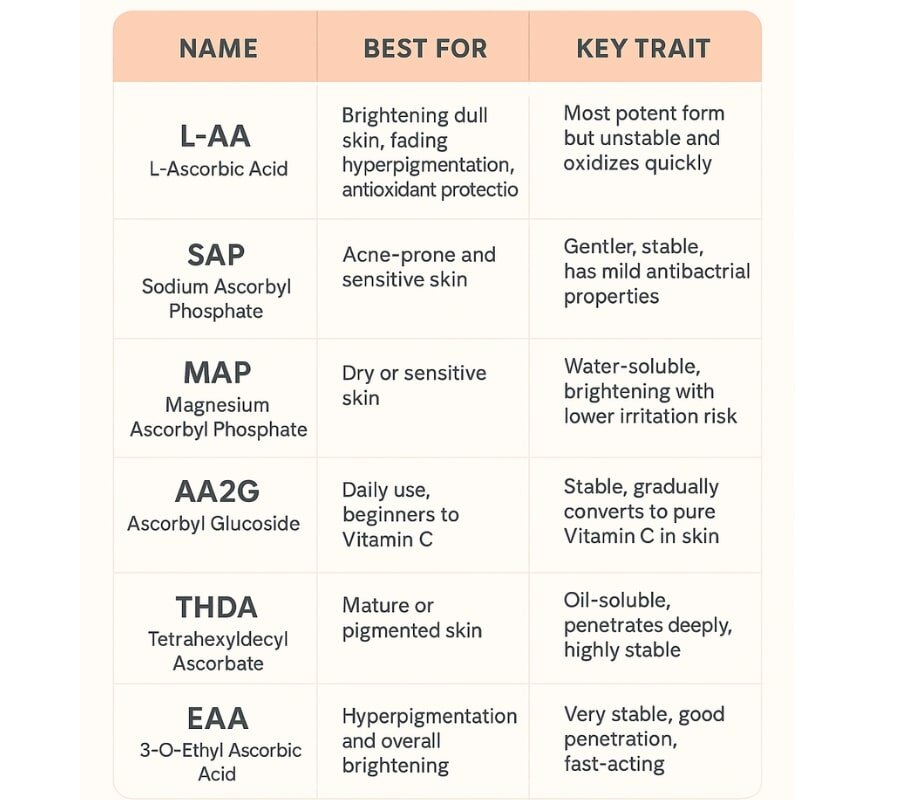
✅ QUICK TIPS
- L-AA is most effective but can irritate sensitive skin.
- SAP and MAP are ideal for gentle daily use.
- THDA is excellent for deep antioxidant protection.
Part 3: Your Serum Buying Guide – How to Choose a Winner
Now that you know the types, here’s what to look for on the label and the bottle.
- The Power Trio: C + E + Ferulic Acid: A landmark study proved that combining L-Ascorbic Acid with Vitamin E and Ferulic Acid creates a powerful synergistic effect. It not only stabilizes the L-AA, but it also increases its antioxidant protection by a factor of eight. If you are choosing an L-AA serum, this combination is the gold standard.
- Concentration Matters:
- For L-Ascorbic Acid, the effective range is between 10% and 20%. Anything lower may not be effective, and anything higher dramatically increases the potential for irritation with little added benefit.
- For derivatives, concentrations can vary, but generally fall between 5% and 15%.
- Packaging is Paramount: This is a non-negotiable deal-breaker. Because of its instability (especially L-AA), your Vitamin C serum must be housed in an opaque, dark glass (amber or cobalt blue), or airless pump bottle. If it’s in a clear bottle, do not buy it—the light will have already degraded the product before you even open it.
- Check the Color and Smell: A fresh L-Ascorbic Acid serum should be clear to a very pale champagne color. If it is dark yellow, orange, or brown, it has oxidized and will be ineffective and potentially pro-inflammatory. It often has a unique, slightly metallic or “hot dog water” smell; this is normal for L-AA + Ferulic Acid serums and is a sign of a potent formula.
Part 4: The Application Masterclass – How to Use Your Serum Correctly
- When to Apply: Vitamin C is best used in the morning (A.M.). Its powerful antioxidant properties create a shield that works in synergy with your sunscreen to provide optimal protection against UV and environmental damage.
- The Order of Application: Apply your Vitamin C serum to clean, dry skin after cleansing (and after any watery toners).
- How Much to Use: A little goes a long way. 3-5 drops is all you need for your entire face and neck.
- The Technique: Dispense the drops into the palm of your hand, then use your fingertips to gently pat or press the serum into your skin. Avoid rubbing.
- The All-Important Pause: Allow the serum to fully absorb for at least 60-90 seconds before applying your moisturizer. This is especially important for low-pH L-AA serums to ensure they work at maximum efficacy.
- The Final Step: Sunscreen. Following up with a broad-spectrum sunscreen is essential. Using Vitamin C makes your sunscreen work better, and using sunscreen protects your skin from the damage Vitamin C is trying to prevent. They are the ultimate power couple. We break down the best options in our Ultimate Guide to Face Sunscreens.
- Storage: To prolong its life, store your Vitamin C serum in a cool, dark place, like a medicine cabinet or even your refrigerator.
FAQ Section: Your Vitamin C Questions, Answered

- 1. My Vitamin C serum tingles when I apply it. Is that normal?
- A mild, temporary tingling can be normal with L-Ascorbic Acid serums due to their low pH. However, if you experience persistent stinging, burning, or redness, the formula is likely too strong for you. Consider switching to a gentler derivative.
- 2. Can I use Vitamin C with Niacinamide?
- Yes. This is a common myth based on outdated research. Modern, stable formulations of both ingredients can be used in the same routine without issue. To be safe, you can apply Niacinamide after your Vitamin C has fully absorbed. We cover this superstar ingredient in our Niacinamide Deep Dive.
- 3. What about using Vitamin C with Retinol?
- It is generally recommended to separate them to avoid potential irritation, especially for beginners. The standard professional advice is: Vitamin C in the morning, Retinol at night. This allows each powerhouse ingredient to work at its optimal time without interference.
- 4. My skin is breaking out after starting a new Vitamin C serum. Why?
- While Vitamin C itself isn’t typically comedogenic, the base formula of the serum might be. Many serums contain silicones or oils that can clog pores in acne-prone individuals. If this happens, consider switching to a lighter, oil-free formula or one that uses Sodium Ascorbyl Phosphate (SAP), which is known to be beneficial for acne.
- 5. Do I still need a Vitamin C serum if I eat a lot of oranges?
- Yes. While dietary Vitamin C is crucial for your overall health, only a very small amount actually makes it to your skin. Topical application delivers a much higher, more direct concentration to the skin cells, which is necessary to achieve the protective and anti-aging benefits.
Conclusion: Your Daily Dose of Radiance
A well-formulated Vitamin C serum is not a luxury; it is a fundamental pillar of a truly effective, protective, and preventative skincare routine. By moving past the hype and understanding the science—choosing the right form for your skin, insisting on protective packaging, and mastering the application—you can finally stop wondering if your serum is working. You can be confident that you are providing your skin with its daily dose of antioxidant protection, paving the way for a brighter, firmer, and undeniably healthier complexion.

