


It’s one of the most fundamental steps in any skincare routine, often dismissed as a simple hydration step. You apply it every day, perhaps without much thought, assuming “a moisturizer is a moisturizer.” But if your skin feels perpetually dry despite constant application, or if your complexion feels greasy and breakout-prone even after cleansing, your moisturizer might not just be ineffective—it could be actively sabotaging your skin’s health and appearance.
The truth is, not all moisturizers are created equal. Formulations vary wildly, each designed to address specific needs, from battling extreme dryness to regulating oil production. Using the wrong type of moisturizer can disrupt your skin barrier, exacerbate existing problems, and even counteract the benefits of your other carefully chosen skincare products.
This is your definitive guide to understanding the unsung hero of your skincare routine. We will break down the science of hydration, demystify the different types of moisturizers, and provide a clear framework to help you choose the perfect match for your unique skin type. It’s time to stop guessing and start supporting your skin with the right kind of moisture.
Part 1: The Science of Skin Hydration – Why Moisturizer is Non-Negotiable
Before we dive into product types, let’s understand the critical role your moisturizer plays. Your skin’s outermost layer, the stratum corneum (often described as a “brick and mortar” structure of skin cells and lipids), is your primary barrier. A healthy skin barrier is essential for:
- Retaining Moisture: It prevents Transepidermal Water Loss (TEWL), keeping vital water locked in your skin.
- Protecting from External Aggressors: It shields your skin from pollutants, irritants, and bacteria.
When your skin barrier is compromised (often due to environmental factors, harsh products, or using the wrong moisturizer), you experience dryness, sensitivity, redness, and even increased breakouts. A well-formulated moisturizer supports and repairs this crucial barrier. It’s the final “Moisturize” pillar we identified in our Foundational Guide to Building a Skincare Routine.
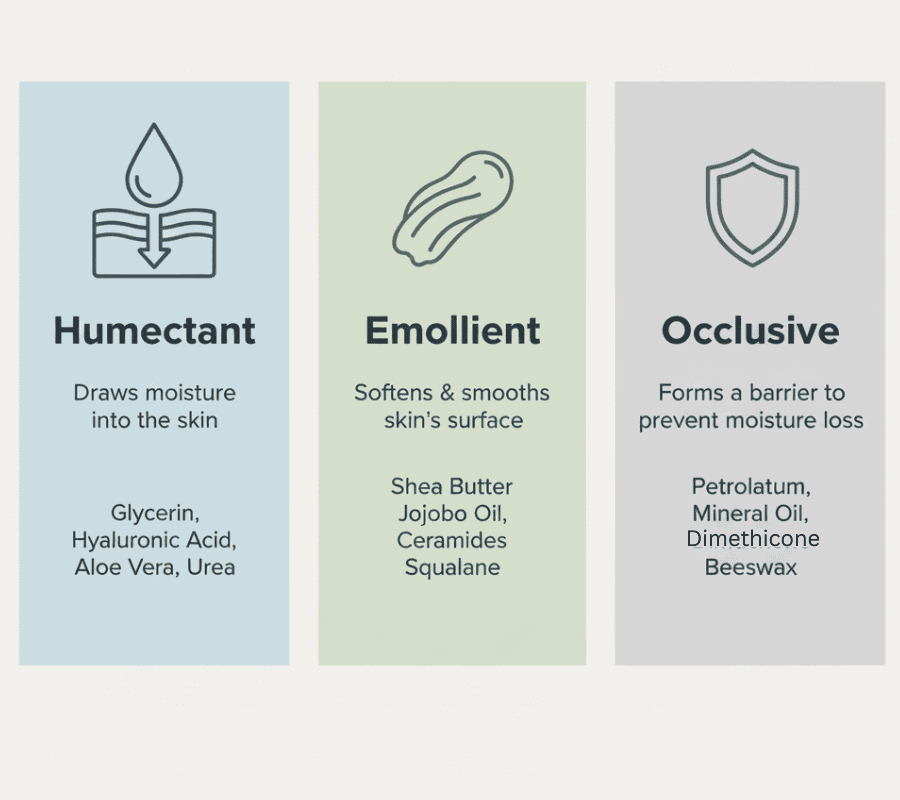
The Three Pillars of Moisturizer Ingredients:
Most effective moisturizers contain a blend of three key ingredient categories:
- Humectants: These are moisture-attracting ingredients that draw water into the skin from the atmosphere or from deeper layers of the skin.
- Key Ingredients: Hyaluronic Acid, Glycerin, Urea, Sodium PCA.
- Emollients: These are ingredients that smooth and soften the skin, filling in the gaps between skin cells. They improve skin texture and flexibility.
- Key Ingredients: Fatty acids (e.g., Linoleic Acid), ceramides, cholesterol, plant oils (e.g., Jojoba, Squalane).
- Occlusives: These are ingredients that form a physical barrier on the skin’s surface to prevent water from evaporating (reducing TEWL). They are key for sealing in hydration.
- Key Ingredients: Petrolatum, Mineral Oil, Dimethicone, Shea Butter, Lanolin, Waxes.
The best moisturizers often contain a strategic blend of all three, but the ratio of these ingredients determines the moisturizer’s texture and suitability for different skin types.
Part 2: Finding Your Perfect Match – Moisturizers for Every Skin Type
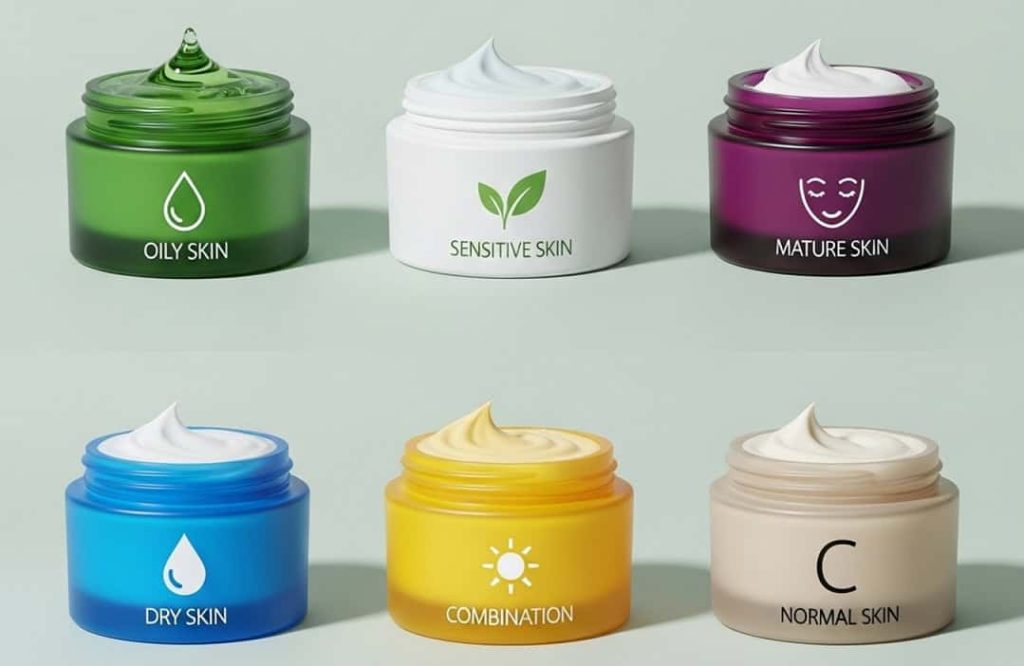
The most common mistake is using a moisturizer not suited for your skin. Here’s how to choose based on your specific needs.
1. For Oily & Acne-Prone Skin: The Lightweight Gel or Fluid
- The Problem: Oily skin overproduces sebum, leading to shine, congested pores, and breakouts. Many oily individuals mistakenly skip moisturizer, which can backfire, causing the skin to produce even more oil to compensate for dehydration.
- The Solution: You need a lightweight, non-comedogenic, oil-free gel or fluid moisturizer.
- Key Ingredients to Look For:
- Humectants: High concentrations of Hyaluronic Acid and Glycerin to provide hydration without heaviness.
- Oil-Regulators: Niacinamide (which we covered in our Niacinamide Deep Dive), Salicylic Acid (at low concentrations).
- Light Emollients/Occlusives: Dimethicone (silicone-based), Squalane (plant-derived and non-comedogenic).
- What to Avoid: Heavy creams, rich oils, shea butter, petrolatum (unless specifically formulated to be non-comedogenic).
- Texture Profile: Absorbs quickly, leaves a matte or natural finish, feels weightless.
2. For Combination Skin: The Balancing Lotion
- The Problem: The dreaded “T-zone” (oily forehead, nose, chin) combined with normal or dry cheeks. This requires a balanced approach.
- The Solution: A light-to-medium weight lotion that provides adequate hydration without overwhelming the oily areas or under-hydrating the dry ones.
- Key Ingredients to Look For:
- Balanced Humectants/Emollients: A mix of Hyaluronic Acid, Glycerin, Ceramides.
- Pore-Refiners: Niacinamide is excellent for controlling oil in the T-zone and refining texture.
- Texture Profile: Spreads easily, provides a soft, satin finish, feels comfortable without being heavy.
3. For Normal Skin: The Versatile Lotion or Cream
- The Problem: Lucky you! Normal skin is well-balanced, neither excessively oily nor dry, with minimal sensitivity. Your goal is maintenance and prevention.
- The Solution: You have the most flexibility. A light-to-medium weight cream or lotion is perfect for maintaining health.
- Key Ingredients to Look For:
- Antioxidants: Vitamin C (often paired with Vitamin E and Ferulic Acid as we detailed in our Vitamin C Guide), green tea extract.
- Skin-Identical Ingredients: Ceramides, Cholesterol, Fatty Acids to reinforce the barrier.
- Texture Profile: Smooth, comfortable, leaves a healthy, natural finish.
4. For Dry Skin: The Rich Cream or Balm
- The Problem: Dry skin lacks both water (dehydration) and oil (lipids), leading to tightness, flakiness, rough texture, and increased sensitivity. The barrier is often compromised, leading to significant TEWL.
- The Solution: A rich, emollient-heavy cream or a nourishing balm. These formulations prioritize ingredients that create a protective layer.
- Key Ingredients to Look For:
- High Occlusive/Emollient Blend: Shea Butter, Squalane, Petrolatum, Mineral Oil, Lanolin (if not sensitive to it).
- Barrier-Repairing: Ceramides, Cholesterol, Fatty Acids.
- Humectants: Glycerin, Hyaluronic Acid (but always sealed in by occlusives).
- What to Avoid: Gel moisturizers, alcohol-heavy formulas.
- Texture Profile: Thick, creamy, luxurious, provides a comforting protective layer.
5. For Sensitive Skin: The Unscented, Minimalist Formula
- The Problem: Reactive skin prone to redness, itching, stinging, and breakouts when exposed to common irritants.
- The Solution: Look for products specifically labeled “for sensitive skin,” “hypoallergenic,” and “fragrance-free” (not just “unscented,” which can still contain masking fragrances). Prioritize minimalist formulas with few ingredients.
- Key Ingredients to Look For:
- Soothing & Barrier Repair: Ceramides, Niacinamide, Colloidal Oatmeal, Centella Asiatica (Cica), Allantoin.
- What to Avoid: Fragrances (natural and synthetic), essential oils, dyes, harsh alcohols, certain botanical extracts.
6. For Mature Skin: The Targeted Anti-Aging Cream
- The Problem: Mature skin often experiences increased dryness, loss of elasticity, and more prominent lines and wrinkles due to declining collagen and slower cell turnover.
- The Solution: A rich, nourishing cream that combines strong hydration with targeted anti-aging actives.
- Key Ingredients to Look For:
- Peptides: To stimulate collagen production.
- Growth Factors: To support cellular repair and regeneration.
- Antioxidants: Vitamin C, Vitamin E, Ferulic Acid (as discussed in our Vitamin C Guide).
- Retinoids: If not already using a separate retinol serum, some moisturizers contain gentle forms of retinol. For serious anti-aging, a dedicated retinol serum is often more effective.
- Texture Profile: Often richer, luxurious, designed to provide a plump, supple feel.
Part 3: The Application Masterclass – Maximize Your Moisture
Even the perfect moisturizer can underperform if not applied correctly.
- Apply to Damp Skin: The ideal time to apply moisturizer is within a few minutes of cleansing or after applying your serums, while your skin is still slightly damp. This helps to trap existing moisture on the skin.
- The Right Amount: Don’t skimp, but don’t overdo it. A nickel-sized amount is usually sufficient for the face and neck.
- Gentle Massage: Use upward, circular motions to gently massage the moisturizer into your skin. This aids absorption and can boost circulation.
- Don’t Forget Your Neck and Decolletage: These areas show signs of aging just as quickly as your face. Extend your moisturizer down to them.
- A.M. vs. P.M.: You can use the same moisturizer for both, or opt for a lighter formula in the morning (especially if you’re layering SPF and makeup) and a richer, more restorative cream at night (especially after using actives like retinoids).
FAQ Section: Your Moisturizer Questions, Answered

- 1. Is “oil-free” always better for oily skin?
- Not necessarily. “Oil-free” just means it doesn’t contain traditional oils. Many “oil-free” moisturizers still contain silicones or other emollients that provide hydration. The key is “non-comedogenic,” meaning it won’t clog pores. Some plant-based oils (like Squalane) can actually be beneficial for oily skin without causing breakouts.
- 2. Can I use my facial oil instead of a moisturizer?
- Facial oils are primarily occlusive and emollient. They are excellent for sealing in moisture and adding nourishment, but they don’t contain humectants (like Hyaluronic Acid) that draw water into the skin. For optimal hydration, it’s best to use an oil over a water-based serum or a traditional moisturizer to lock in those humectants.
- 3. What’s the difference between a day cream and a night cream?
- Day creams often prioritize lighter textures, absorb quickly, and may contain SPF or antioxidants for daytime protection. Night creams are typically richer, more nourishing, and may contain higher concentrations of reparative ingredients to support the skin’s natural regeneration processes while you sleep.
- 4. My skin still feels dry, even with moisturizer. What’s wrong?
- This could be several issues:
- Dehydrated skin: You might need to layer a hydrating serum (like Hyaluronic Acid) under your moisturizer.
- Compromised barrier: Your moisturizer might not contain enough occlusives or barrier-repairing ingredients.
- Product absorption: Ensure you’re applying to slightly damp skin and allowing time for absorption.
- Underlying issues: Sometimes, true chronic dryness requires consulting a dermatologist.
- This could be several issues:
Conclusion: The Pillar of a Healthy Complexion
Your moisturizer is far more than just a cream you apply daily. It is the cornerstone of your skin’s health, the guardian of your barrier, and the silent hero that supports all your other active ingredients. By moving beyond generic selections and choosing a moisturizer specifically formulated for your skin type, you empower your skin to perform its best—to be hydrated, resilient, and radiantly healthy. It’s time to give this essential step the thoughtful consideration it truly deserves.

