


You’ve dedicated time and effort to your routine. Your skin is prepped, your primer is blurred, and your foundation is seamlessly blended. You feel flawless. But then, life happens. A humid commute, a long day of meetings, an evening out with friends. By the time you catch your reflection, the masterpiece you created has begun to melt, fade, and settle. It’s a dishearteningly common experience that leaves many wondering: is there a final step I’m missing?
Enter the setting spray. Housed in unassuming bottles, these mists promise to be the invisible shield for your makeup, locking everything in place for hours on end. But are they a genuinely necessary final step, or just another clever marketing gimmick?
The answer is unequivocal: a high-quality, correctly chosen setting spray is one of the most transformative products in a modern makeup routine. This guide will move beyond the hype to explain the science of how they work, break down the different types, and reveal our top 5 formula archetypes for 2025 so you can finally make your makeup bulletproof.
Part 1: The Science Behind the Mist – What’s Actually in a Setting Spray?
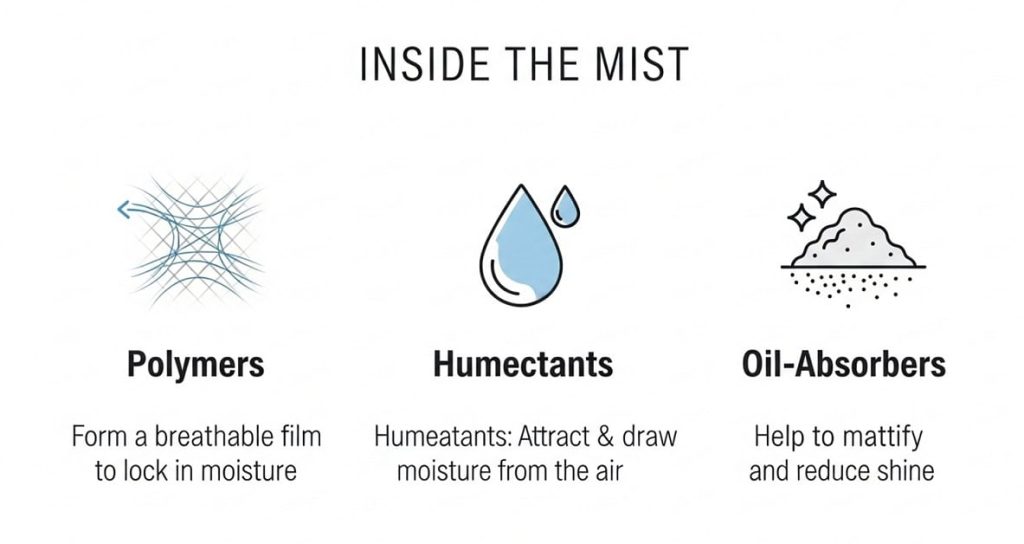
To appreciate its power, you must understand that a setting spray is not just “water in a bottle.” It is a sophisticated cosmetic formulation designed to perform specific functions. The magic lies in a key group of ingredients called polymers.
- The “Film-Formers”: The most important ingredients are polymers like PVP (Polyvinylpyrrolidone) or acrylates copolymers. When you spray them onto your face, the liquid carrier (usually water and sometimes alcohol) evaporates, leaving behind these polymers. The polymers link together to form a flexible, breathable, invisible mesh or “film” over your makeup. This film holds everything in place, preventing it from smudging, fading, or transferring. It’s quite literally like a lightweight, flexible hairspray for your face.
- The Finish-Modifiers: Beyond setting, these sprays are designed to perfect your final look.
- For Matte Finishes: Sprays will contain oil-absorbing ingredients like silica, charcoal powder, or kaolin clay that help control sebum production and maintain a shine-free look.
- For Dewy Finishes: Sprays are packed with humectants like glycerin, hyaluronic acid, and panthenol, which attract moisture from the air, and emollients like botanical oils to impart a radiant, skin-like glow.
Understanding this allows you to see that a setting spray is the final, crucial step that fuses all the layers of your makeup together, as we mapped out in our Ultimate Guide to a Flawless Foundation Base.
Part 2: The Setting Spray Spectrum – Choosing Your Perfect Formula
Not all sprays are created equal. In 2025, the market is highly specialized. Choosing the right one depends entirely on your skin type and desired finish.
- Matte Setting Sprays: These are the heavy-lifters designed for ultimate longevity. They typically contain a higher concentration of film-forming polymers and oil-absorbers.
- Best For: Oily and combination skin, special events, humid climates, and anyone who needs their makeup to last 12+ hours without budging.
- The Effect: Creates a velvety, shine-free finish that locks makeup down completely.
- Dewy/Radiant Setting Sprays: These sprays focus on melting products together and imparting a luminous glow.
- Best For: Dry, normal, and mature skin. Also perfect for anyone who wants to take down the “powdery” look after setting their makeup.
- The Effect: Creates a radiant, “lit-from-within” glow. It makes powder products look like they are part of the skin, a key technique when choosing between Cream or Powder Formulas.
- Hydrating Mists (The “Refresher”): It’s important to distinguish these from true setting sprays. While they can be used at the end of a routine, their primary function is skincare. They have a lower concentration of polymers and a higher concentration of hydrating and soothing ingredients.
- Best For: All skin types for a midday refresh, prepping the skin before makeup, or for a very natural, “no-makeup” look.
- The Effect: Provides a burst of hydration and can give a temporary dewy look, but offers minimal long-term setting power.
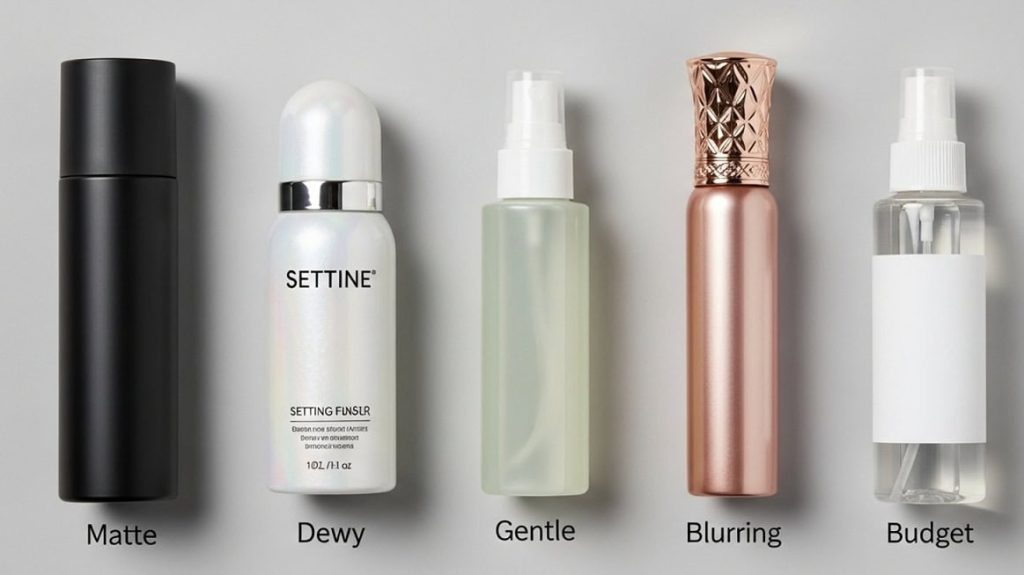
Part 3: The 2025 Edit – Our Top 5 Setting Spray Archetypes
Instead of just naming products, we’re breaking down the top-performing types of formulas on the market right now. This allows you to find the perfect product from any brand that fits the profile.
1. The All-Day Matte Lock
- The Profile: This is the industry gold standard for locking power. It’s a micro-fine mist that creates an impressively strong yet flexible film. Often contains a small amount of alcohol to help the formula evaporate quickly and patented temperature-control technology to keep makeup cool.
- Who Needs It: The oily-skinned individual, the bride, the performer, or anyone who absolutely cannot have their makeup move.
- Look For: High concentration of polymers (PVP, AMP-Acrylates), Temperature-Control Technology.
2. The Glass Skin Glow Mist
- The Profile: This spray is less about locking down and more about melting and glowing. It’s packed with glycerin and contains ultra-fine, pearlescent particles that catch the light beautifully. It’s the secret to making a powdered face look dewy and skin-like.
- Who Needs It: The dry-skinned person who finds powder aging, or anyone aiming for that ultra-radiant, dewy finish we explored in our Dewy vs. Matte Guide.
- Look For: Glycerin as a top ingredient, Mica, Squalane, Hydrating Botanicals.
3. The Alcohol-Free Gentle Setter
- The Profile: Catering to the sensitive skin market, this formula provides impressive setting power without any denatured alcohol. It often uses innovative water-based polymers and has a slightly tacky feel initially that creates a “gripping” effect.
- Who Needs It: Anyone with sensitive, reactive, or very dry skin who finds traditional setting sprays irritating or drying.
- Look For: “Alcohol-Free” on the label, Aloe Vera, Hyaluronic Acid, Niacinamide.
4. The Ultra-Fine Blurring Mist
- The Profile: This is the luxury option, known for its aerosol-like, cloud-soft mist. The formula focuses on creating a “soft-focus” or “airbrushed” effect. It sets makeup with a natural, skin-like finish that is neither too matte nor too dewy and often contains skin-blurring ingredients.
- Who Needs It: The makeup perfectionist who wants longevity without sacrificing a natural finish. It’s the ultimate “best of both worlds” spray.
- Look For: An ultra-fine atomizer nozzle, Film-Forming Polymers, ingredients like Japanese Green Tea.
5. The Budget-Friendly Workhorse
- The Profile: This drugstore hero proves you don’t need to spend a fortune. It’s a versatile spray that can be used to set, refresh, and prime. The finish is typically a natural satin, and it offers reliable performance for everyday wear.
- Who Needs It: The makeup beginner, the person on a budget, or anyone looking for a great all-arounder for their daily routine.
- Look For: A great price point, multi-use claims (e.g., “3-in-1”), and overwhelmingly positive online reviews.
Part 4: The Application Masterclass – You’re Probably Doing It Wrong
The best formula in the world will fail if applied incorrectly.
- The Golden Distance: Hold the bottle about 8-10 inches (20-25 cm) away from your face. Too close, and you’ll get disruptive, wet splotches. Too far, and the mist will evaporate before it even reaches you.
- The “X” and “T” Formation: The most effective way to cover your entire face evenly is to first spray in an “X” formation from forehead to chin, then again in a “T” formation across the forehead and down the nose.
- The Pro-Grip Technique: For ultimate longevity, spray your setting spray onto your foundation brush or makeup sponge before you blend your foundation. This infuses the setting power directly into your base layer.
- Intensify Your Eyeshadow: Spray a flat eyeshadow brush with your setting spray before dipping it into a metallic or shimmer eyeshadow. It will transform the powder into a molten, high-impact, long-wearing liquid metal.
FAQ Section: Your Setting Spray Questions, Answered

- 1. What’s the difference between a “setting spray” and a “fixing spray”? Historically, “fixing sprays” were heavy-duty, often alcohol-heavy formulas used in theater to truly lock down makeup. “Setting sprays” were more about melting powders and providing a finish. In 2025, the terms are used almost interchangeably by most brands, but a spray marketed as a “fixing” spray will likely have the strongest hold.
- 2. Can I use hairspray as a setting spray? Absolutely not. This is a dangerous beauty myth. Hairsprays contain harsh lacquers and high concentrations of alcohol that are not formulated for facial skin. They can cause severe allergic reactions, breakouts, and extreme dryness.
- 3. Why does my setting spray sometimes leave little white dots on my face? This usually means the nozzle is clogged with dried product, causing it to sputter instead of mist. To fix this, run the nozzle under warm water and use a pin to gently clear the opening. It can also happen if you don’t shake the bottle well, especially with matte formulas that contain powders.
- 4. Is it bad to use a setting spray with alcohol every day? For many people, especially those with oily skin, it’s perfectly fine. However, if you have dry or sensitive skin, daily use of a spray with a high concentration of denatured alcohol could lead to dryness or irritation over time. If this is a concern, opt for one of the excellent alcohol-free formulas now available.
- 5. Do I still need to use powder if I use a setting spray? It depends on your needs. For oily skin, using both is the ultimate combo for a bulletproof base: powder controls the oil, and the spray locks everything in. For dry skin, you can often skip powder entirely and just use a dewy setting spray to set your makeup and provide a radiant finish.
Conclusion: The Essential Final Seal
So, does your makeup really need a setting spray? If you want it to look as flawless at the end of the day as it did in the beginning, then the answer is a definitive yes. It is not an extraneous luxury; it is the essential final step that acts as the lock and key for your entire look. By understanding the science, choosing a formula that serves your skin type and desired finish, and mastering the application, you elevate your makeup from a fleeting moment of perfection into a state of all-day confidence.

